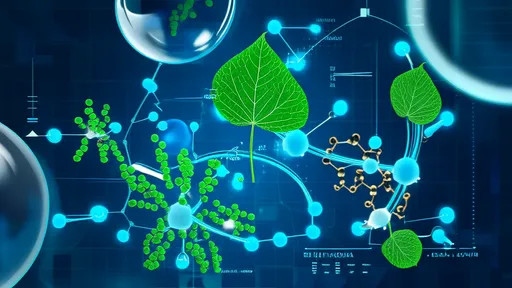
In a groundbreaking advancement for plant metabolic engineering, researchers have successfully developed a novel "metabolic flowmeter" technology that enables real-time monitoring of artemisinin biosynthesis in Artemisia annua (sweet wormwood). This innovation promises to revolutionize how scientists understand and optimize the production of this life-saving antimalarial compound.
The technology, described as the first of its kind, provides unprecedented visibility into the dynamic metabolic fluxes occurring throughout the artemisinin synthesis pathway. Unlike traditional methods that offer only snapshots of metabolic states, this system tracks the actual flow of precursors through the complex biochemical network that ultimately produces artemisinin.
How the Metabolic Flowmeter Works
At the heart of the system lies a sophisticated combination of isotopic labeling techniques and advanced computational modeling. Researchers introduce stable isotope-labeled precursors into living Artemisia annua plants or cell cultures, then track their incorporation into various intermediates using cutting-edge mass spectrometry platforms. What sets this approach apart is its ability to distinguish between different flux routes and quantify their relative contributions to artemisinin production.
The team developed custom algorithms that process the mass spectrometry data in near real-time, generating a dynamic map of carbon flow through the entire biosynthetic pathway. This includes not just the well-characterized later steps of artemisinin formation, but also the often-overlooked upstream processes that supply critical precursors.
Overcoming Historical Challenges
For decades, researchers have struggled to understand the complete picture of artemisinin biosynthesis due to the pathway's complexity and compartmentalization within plant cells. Traditional metabolite profiling could identify what compounds were present, but couldn't reveal how quickly they were being made, interconverted, or degraded. The metabolic flowmeter finally provides these missing kinetic parameters.
One particularly valuable insight has been the ability to track carbon flow through competing branch points in the pathway. The technology clearly shows how precursors are partitioned between artemisinin production and other terpenoid compounds, revealing previously unknown regulatory nodes that could become targets for metabolic engineering.
Immediate Applications in Strain Improvement
The research team has already begun applying their technology to improve artemisinin yields. By monitoring flux changes in response to different genetic modifications or culture conditions, they can now identify the most effective interventions without time-consuming trial-and-error approaches.
Early successes include identifying several previously unrecognized bottleneck enzymes in high-yielding strains. Surprisingly, some enzymes long assumed to be limiting showed adequate capacity, while others not previously considered emerged as critical constraints on artemisinin production.
Beyond Artemisinin: Broader Implications
While developed specifically for artemisinin, the metabolic flowmeter concept has far-reaching implications for plant metabolic engineering generally. The same principles could be applied to study and optimize the production of other valuable plant-derived pharmaceuticals, nutraceuticals, or industrial compounds.
Researchers particularly highlight the technology's potential for investigating how environmental factors influence metabolic fluxes. Preliminary data already suggest that light intensity and spectral quality affect not just overall artemisinin accumulation, but the actual routing of precursors through alternative pathway branches.
Commercialization and Future Directions
The team is working to commercialize scaled-down versions of the technology for industrial applications. One prototype system allows semi-continuous monitoring of artemisinin flux in bioreactor cultures, providing manufacturers with real-time data to optimize production conditions.
Future developments aim to increase temporal resolution and reduce the need for isotopic labeling. The researchers envision a day when similar flux monitoring could be performed non-invasively, perhaps through advanced spectroscopic techniques combined with machine learning algorithms trained on the current dataset.
This metabolic flowmeter represents more than just a technical achievement - it fundamentally changes how we can study and manipulate complex plant metabolic pathways. As artemisinin demand continues to grow amid spreading antimalarial resistance, such innovations will be crucial for ensuring reliable, affordable supplies of this essential medicine.
By /Aug 18, 2025
By /Aug 18, 2025

By /Aug 18, 2025

By /Aug 18, 2025

By /Aug 18, 2025

By /Aug 18, 2025

By /Aug 18, 2025

By /Aug 18, 2025

By /Aug 18, 2025
By /Aug 18, 2025

By /Aug 18, 2025
By /Aug 18, 2025
By /Aug 18, 2025
By /Aug 18, 2025
By /Aug 18, 2025
By /Aug 18, 2025
By /Aug 18, 2025
By /Aug 18, 2025
By /Aug 18, 2025
By /Aug 18, 2025
