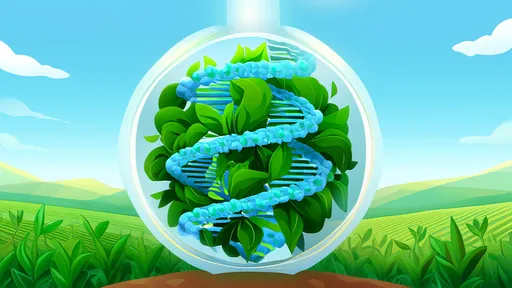
The agricultural landscape is undergoing a silent revolution, one driven not by tractors or fertilizers, but by the invisible code of life itself: DNA. At the forefront of this transformation is a powerful technique known as genomic selection, a method that is fundamentally reshaping the art and science of crop breeding. Unlike traditional approaches that relied on observable traits and lengthy field trials, genomic selection allows scientists to predict a plant's potential from its genetic blueprint long before it ever flowers or bears fruit. This paradigm shift is accelerating the development of superior crop varieties with unprecedented speed and precision, offering a potent weapon in the global fight for food security.
The core principle of genomic selection hinges on the creation of a robust prediction model. Breeders begin by assembling a large training population—a diverse set of plants that have been both genotyped (their DNA scanned for thousands of genetic markers) and phenotyped (thoroughly evaluated for key traits like yield, drought tolerance, or disease resistance). Sophisticated statistical models are then employed to crunch this massive dataset, establishing correlations between specific genetic marker patterns and the desired phenotypic outcomes. Once this model is calibrated and validated, it becomes an incredibly powerful forecasting tool. For any new plant, a simple DNA scan is sufficient. Its genetic data is fed into the model, which then generates a Genomic Estimated Breeding Value (GEBV)—a single-number prediction of its genetic worth for the targeted traits. This allows breeders to identify the most promising candidates while they are still seedlings, saving years of field testing and resources.
The advantages of this data-driven approach over conventional breeding are profound and multifaceted. The most significant benefit is the dramatic reduction in the breeding cycle time. Traditional methods often require growing plants to maturity over multiple seasons to observe their characteristics. With genomic selection, decisions can be made within a single generation, slashing development times for new varieties from a decade or more to just a few years. This acceleration is crucial for rapidly addressing emerging threats, such as new pest strains or shifting climate patterns. Furthermore, the technique excels in selecting for complex traits controlled by many genes, each with a small effect—traits that have historically been exceedingly difficult to improve through traditional selection. It also facilitates the selection of characteristics that are expensive or cumbersome to measure directly, such as root architecture or nutrient use efficiency, by relying solely on the genetic predictors.
The real-world impact of genomic selection is already being felt across a wide spectrum of staple crops, heralding a new era of agricultural productivity. In maize breeding, for instance, it has become an indispensable tool for enhancing yield stability and drought tolerance. Major seed companies and international research centers now routinely use genomic selection to identify parent lines that will produce hybrids capable of thriving in suboptimal conditions. Similarly, in wheat breeding programs, the technology is accelerating the development of lines with improved resistance to rust diseases and enhanced nutritional profiles, such as higher zinc and iron content. The application extends to perennial crops as well; in fruit trees like apple and cherry, where generation times are exceptionally long, genomic selection offers the promise of developing improved varieties in a fraction of the time, a development that was once thought impossible.
Despite its transformative potential, the widespread adoption of genomic selection is not without its significant challenges. The initial setup requires a substantial investment in both infrastructure and expertise. High-throughput genotyping platforms, bioinformatics capacity, and sophisticated computing resources are necessary to handle the immense volumes of data, posing a barrier for many public-sector and smaller breeding programs, particularly in developing nations. There is also the persistent challenge of genotype-by-environment interaction; a model trained on data from one region may not accurately predict performance in another with different soils and climates, necessitating the development of localized models. Furthermore, an over-reliance on genomic predictions could potentially lead to a narrowing of the genetic base if not managed carefully, making crops more vulnerable to future unforeseen threats.
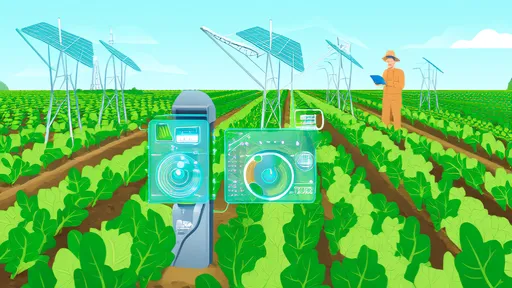
Looking ahead, the future of genomic selection is intrinsically linked to advancements in adjacent technological fields. The integration of machine learning and artificial intelligence is poised to create even more powerful and nuanced prediction models capable of deciphering complex non-linear relationships within genetic data. Meanwhile, progress in phenomics—the high-throughput, automated measurement of plant traits using drones and sensors—will provide the vast and precise phenotypic data needed to train these next-generation models. The ultimate goal is the development of a holistic, digital breeding platform where genomic selection operates in synergy with other cutting-edge tools like gene editing, enabling the design and development of ideal crop varieties with surgical precision to meet the demands of a growing global population in a changing climate.
In conclusion, genomic selection represents far more than just a technical upgrade to traditional breeding; it is a fundamental leap forward. By leveraging the predictive power of genetics, it has dismantled the time-consuming barriers that have long constrained progress in agriculture. While challenges in accessibility and implementation remain, the trajectory is clear. This technology is steadily becoming the cornerstone of modern crop improvement, empowering breeders to compose a more resilient, productive, and sustainable future for global agriculture, one genome at a time. Its continued refinement and integration promise to unlock possibilities in crop design that were once confined to the realm of science fiction.

By /Aug 25, 2025

By /Aug 25, 2025
By /Aug 25, 2025

By /Aug 25, 2025

By /Aug 25, 2025

By /Aug 25, 2025

By /Aug 25, 2025

By /Aug 25, 2025

By /Aug 25, 2025

By /Aug 25, 2025

By /Aug 25, 2025

By /Aug 25, 2025

By /Aug 25, 2025

By /Aug 25, 2025

By /Aug 25, 2025
By /Aug 25, 2025
By /Aug 25, 2025
By /Aug 25, 2025
By /Aug 25, 2025
By /Aug 25, 2025
